Author

admin

Browsing

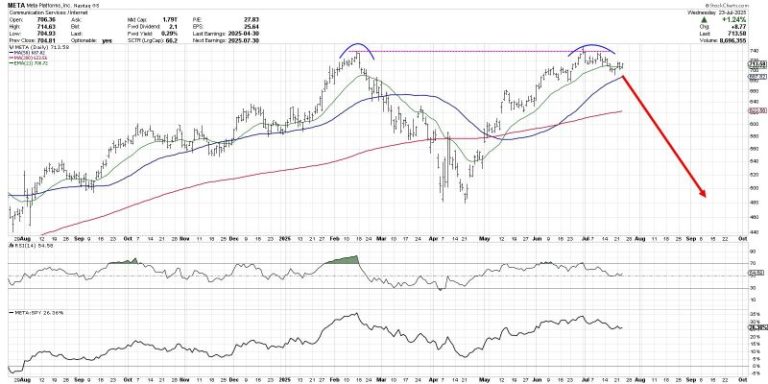
The chart of Meta Platforms, Inc. (META) has completed a roundtrip from the February high around $740 to the April low at $480 and all the way back again.  Over the last couple weeks, META has now pulled back from its retest of all-time highs, leaving investors to wonder what may come next.

Is this the beginning of a new downtrend phase for META?  Or just a brief pullback before a new uptrend phase propels META to new all-time highs?

Today we’ll look at two potential scenarios, including the double top pattern and the cup and handle pattern, and share which technical indicators and approaches could help us determine which path plays out into August.

The double top scenario basically means that the late July retest of the previous all-time high was the end of the recent uptrend phase.  The double top pattern is literally when a major resistance level is set and then retested.  The implication is that a lack of willing buyers means the uptrend is exhausted, and there is nowhere to go but down.

While the 21-day exponential moving average is currently in play for META, I would say that a break below the 50-day moving average could confirm this as the correct scenario.  If that smoothing mechanism does not hold, then the price action would imply less of a pullback and more like the beginning of a real distribution phase.

What is META pulls back but then resumes an uptrend phase, leading META to another new all-time high?  That would result in a confirmed cup and handle pattern, created by a large rounded bottoming pattern followed by a brief pullback.  The key to this pattern is the “rim” of the cup, which sits right at $740 for META.

Given the pullback META has demonstrated so far in July, I would say that a break above the $740 level would basically confirm a bullish cup and handle pattern.  That would suggest much more upside potential for META, as the stock would literally go into previously uncharted territory.

So how can we determine which scenario is more likely to play out?  This is where we need to incorporate more technical indicators into the discussion, as a way to further validate and confirm our investment thesis.

Just to review, I think a break above $740 would confirm a bullish cup and handle pattern.  I would also say that a break below the $680 level, which would represent a move below the 50-day moving average as well as the June swing lows, would basically confirm a bearish double top pattern.

We can also use the Relative Strength Index (RSI) to help determine whether META remains in a bullish trend phase.  During bull phases, the RSI rarely gets below 40, because buyers usually step in to “buy the dips” and keep the momentum fairly constructive.  So if the price would break down, and the RSI would not hold that crucial 40 level, that could mean a bearish outlook is warranted.

Finally, we can use volume-based indicators to assess whether moves in the price are supported by stronger volume readings.  Here I’ve included the Accumulation/Distribution Line, which tracks the trend in daily volume readings over time.  We can see that the high in July resulted in a divergence, as the A/D line was trending lower.  If the A/D line would break below its June and July lows, marked by a dashed red line, that would represent a bearish volume reading for META.

Technical analysis is less about predicting the future, and more about determining the most probable scenarios based on our analysis of trend, momentum, and volume.  I hope this discussion shows how the outlook for META can be easily determined and tracked using the best practices of technical analysis!

RR#6,

Dave

PS- Ready to upgrade your investment process?  Check out my free behavioral investing course!

David Keller, CMT

President and Chief Strategist

Sierra Alpha Research LLC

marketmisbehavior.com

https://www.youtube.com/c/MarketMisbehavior

Disclaimer: This blog is for educational purposes only and should not be construed as financial advice.  The ideas and strategies should never be used without first assessing your own personal and financial situation, or without consulting a financial professional.  

The author does not have a position in mentioned securities at the time of publication.    Any opinions expressed herein are solely those of the author and do not in any way represent the views or opinions of any other person or entity.


Is the market’s next surge already underway? Find out with Tom Bowley’s breakdown of where the money is flowing now and how you can get in front of it.

In this video, Tom covers key moves in the major indexes, revealing strength in transports, small caps, and home construction. He identifies industry rotation signals, which are pointing to aluminum, recreational products, and furnishings. Tom then demonstrates how to use StockCharts’ tools to scan for momentum stocks in emerging leadership groups — see why SGI tops Tom’s list. He ends with a discussion of post-earnings reactions from major names like GOOGL, TSLA, IBM, and LVS. 

And, of course, Tom wraps every idea with clear chart setups you can act on today. 

This video premiered on July 24, 2025. Click this link to watch on Tom’s dedicated page.

Missed a session? Archived videos from Tom are available at this link.

The S&P 500 ($SPX) just logged its fifth straight trading box breakout, which means that, of the five trading ranges the index has experienced since the April lows, all have been resolved to the upside.

How much longer can this last? That’s been the biggest question since the massive April 9 rally. Instead of assuming the market is due to roll over, it’s been more productive to track price action and watch for potential changes along the way. So far, drawdowns have been minimal, and breakouts keep occurring. Nothing in the price action hints at a lasting change — yet.

While some are calling this rally “historic,” we have a recent precedent. Recall that from late 2023 through early 2024, the index had a strong start and gave way to a consistent, steady trend.

From late October 2023 through March 2024, the S&P 500 logged seven consecutive trading box breakouts. That streak finally paused with a pullback from late March to early April, which, as we now know, was only a temporary hiccup. Once the bid returned, the S&P 500 went right back to carving new boxes and climbing higher.

New 52-Week Highs Finally Picking Up

If there’s been one gripe about this rally, it’s that the number of new highs within the index has lagged. As we’ve discussed before, among all the internal breadth indicators available, new highs almost always lag — that’s normal. What we really want to see is whether the number of new highs begins to exceed prior peaks as the market continues to rise, which it has, as shown by the blue line in the chart below.

As of Wednesday’s close, 100 S&P 500 stocks were either at new 52-week highs or within 3% of them. That’s a strong base. We expect this number to continue rising as the market climbs, especially if positive earnings reactions persist across sectors.

Even when we get that first day with 100+ S&P 500 stocks making new 52-week highs, though, it might not be the best time to initiate new longs.

The above chart shows that much needs to align for that many stocks to peak in unison, which has historically led to at least a short-term consolidation, if not deeper pullbacks — as highlighted in yellow. Every time is different, of course, but this is something to keep an eye on in the coming weeks.

Trend Check: GoNoGo Still “Go”

The GoNoGo Trend remains in bullish mode, with the recent countertrend signals having yet to trigger a greater pullback.

Active Bullish Patterns

We still have two live bullish upside targets of 6,555 and 6,745, which could be with us for a while going forward. For the S&P 500 to get there, it will need to form new, smaller versions of the trading boxes.

Failed Bearish Patterns

In the chart below, you can view a rising wedge pattern on the recent price action, the third since April. The prior two wedges broke down briefly and did not lead to a major downturn. The largest pullbacks in each case occurred after the S&P 500 dipped below the lower trendline of the pattern.

The deepest drawdown so far is 3.5%, which is not exactly a game-changer. Without downside follow-through, a classic bearish pattern simply can’t be formed, let alone be broken down from.

We’ll continue to monitor these formations as they develop because, at some point, that will change.

Here are some charts that reflect our areas of focus this week at


XLU Leads with New High

Even though the Utilities SPDR (XLU) cannot keep pace with the Technology SPDR (XLK) and Communication Services SPDR (XLC), it is in a leading uptrend. XLU formed a cup-with-handle from November to July and broke to new highs the last two weeks. ETFs hitting new highs are in strong uptrends and should be on our radar.


Metal Mania in 2025

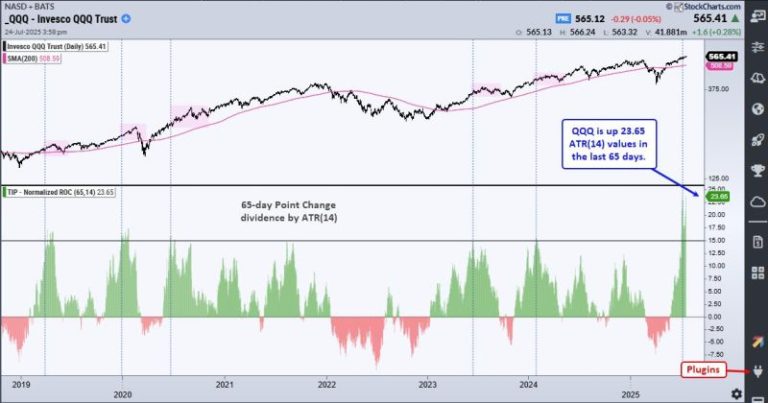
In a tribute to Ozzy, metals are leading the way higher in 2025. The PerfChart below shows year-to-date performance for the continuous futures for 12 commodities. Copper, Platinum and Palladium are up more than 45% year-to-date, while Gold is up 28.38% and Silver is up 35.30%. QQQ is up 10.52% year-to-date, but lagging these metals. The other commodities are mixed.


Multi-Year Highs for Silver and Copper

The next chart shows 11 year bar charts for five metals. Gold broke out in early 2024 and led the metals move with an advance the last 21 months. Silver and copper broke out to multi-year highs. Platinum broke above its 2021 high and Palladium got in the action with an 18 month high. There is a clear message here: metals are moving higher and leading as a group.  


Home Construction Hits Moment of Truth

The Home Construction ETF (ITB) hit its moment of truth as it rose to its falling 40-week SMA. Notice that ITB failed just below this moving average in August 2023. During the 2023-2024 uptrend, the 40-week SMA was more friendly as ITB reversed near this level in October 2023 and June 2024. ITB surged to the falling 40-week SMA in July, but the long-term trend is down and this area could be its nemesis.

Thanks for Tuning in!

See TrendInvestorPro.com for more


/NOT FOR DISTRIBUTION TO UNITED STATES NEWS WIRE SERVICES OR FOR DISSEMINATION IN THE UNITED STATES/

TSX Venture Exchange:   BSK
Frankfurt Stock Exchange:   MAL2

Blue Sky Uranium Corp. (TSXV: BSK,OTC:BKUCF) (FSE: MAL2), (‘Blue Sky’ or the ‘Company’) announces that it has entered into an agreement with Red Cloud Securities Inc. (‘Red Cloud’) to act as agent and sole bookrunner in connection with a ‘best efforts’ private placement (the ‘Marketed Offering’) for the sale of up to 60,000,000 units of the Company (the ‘Units’) at a price of C$0.05 per Unit (the ‘Offering Price’) for aggregate gross proceeds of up to C$3,000,000.

Each Unit will consist of one common share of the Company (each, a ‘Common Share‘) and one common share purchase warrant (each, a ‘Warrant‘). Each Warrant will entitle the holder thereof to purchase one Common Share at a price of C$0.07 at any time on or before that date which is 60 months following the Closing Date (as herein defined).

The Company has also granted Red Cloud an option, exercisable in full or in part up to 48 hours prior to the closing of the Marketed Offering, to sell up to an additional 10,000,000 Units at the Offering Price for additional gross proceeds of up to C$500,000 (the ‘Agent’s Option‘). The Marketed Offering and the securities issuable upon exercise of the Agent’s Option shall be collectively referred to as the ‘Offering‘.

The Company intends to use the net proceeds of the Offering for the exploration and advancement of the Company’s flagship Rio Grande Uranium-Vanadium Project located in the province of Rio Negro in Argentina as well as for general working capital and corporate purposes.

Subject to compliance with applicable regulatory requirements and in accordance with National Instrument 45-106 – Prospectus Exemptions (‘NI 45-106‘), the Units will be offered for sale to purchasers resident in the provinces of British Columbia, Alberta, Manitoba, Saskatchewan and Ontario pursuant to the listed issuer financing exemption under Part 5A of NI 45-106, as amended by Coordinated Blanket Order 45-935 – Exemptions from Certain Conditions of the Listed Issuer Financing Exemption (the ‘Listed Issuer Financing Exemption‘). The Common Shares and Warrants underlying the Units, as well as the Warrant Shares issuable from the Warrants if exercised, are expected to be immediately freely tradeable in accordance with applicable Canadian securities legislation if sold to purchasers resident in Canada. The Units may also be sold in offshore jurisdictions (provided that no prospectus filing or comparable obligation, ongoing reporting requirement or regulatory or governmental approval requirement arises in such jurisdictions) and in the United States on a private placement basis pursuant to one or more exemptions from the registration requirements of the United States Securities Act of 1933, as amended (the ‘U.S. Securities Act‘).

There is an offering document (the ‘Offering Document‘) related to the Offering that can be accessed under the Company’s profile at www.sedarplus.ca and on the Company’s website at: www.blueskyuranium.com. Prospective investors should read this Offering Document before making an investment decision.

The Offering is scheduled to close on November 18, 2025 or such other date as the Company and Red Cloud may agree (the ‘Closing Date‘). Completion of the Offering is subject to certain conditions including, but not limited to, the receipt of all necessary regulatory approvals, including the approval of the TSX Venture Exchange (the ‘TSXV‘).  

This news release does not constitute an offer to sell or a solicitation of an offer to sell any of the securities in the United States. The securities have not been and will not be registered under the U.S. Securities Act or any state securities laws and may not be offered or sold within the United States or to U.S. Persons unless registered under the U.S. Securities Act and applicable state securities laws or an exemption from such registration is available.

About Blue Sky Uranium Corp.

Blue Sky Uranium Corp. is a leader in uranium discovery in Argentina. The Company’s objective is to deliver exceptional returns to shareholders by rapidly advancing a portfolio of uranium deposits into low-cost producers, while respecting the environment, the communities, and the cultures in all the areas in which we work. Blue Sky’s flagship Amarillo Grande Project was an in-house discovery of a new district that has the potential to be both a leading domestic supplier of uranium to the growing Argentine market and a new international market supplier. The Company’s recently optioned Corcovo project has demonstrated potential to host an in-situ recovery uranium deposit. The Company is a member of the Grosso Group, a resource management group that has pioneered exploration in Argentina since 1993.

ON BEHALF OF THE BOARD

‘Nikolaos Cacos’  
______________________________________
Nikolaos Cacos, President, CEO and Director

Neither TSXV nor its Regulation Services Provider (as that term is defined in policies of the TSXV) accepts responsibility for the adequacy or accuracy of this release.

Disclaimer Regarding Forward-Looking Information

This news release contains ‘forward-looking information’ within the meaning of applicable Canadian securities legislation. ‘Forward-looking information’ includes, but is not limited to, statements with respect to activities, events or developments that the Company expects or anticipates will or may occur in the future, including, without limitation, the anticipated timing of closing of the Offering or at all; the anticipated terms of the Units and the Warrants; the anticipated use of the net proceeds of the Offering; the anticipated receipt of all necessary approvals in respect of the Offering; and statements regarding the potential mineral content of the Company’s projects are forward-looking statements and contain forward-looking information. Generally, but not always, forward-looking information and statements can be identified by the use of words such as ‘plans’, ‘expects’, ‘is expected’, ‘budget’, ‘scheduled’, ‘estimates’, ‘forecasts’, ‘intends’, ‘anticipates’, or ‘believes’ or the negative connotation thereof or variations of such words and phrases or state that certain actions, events or results ‘may’, ‘could’, ‘would’, ‘might’ or ‘will be taken’, ‘occur’ or ‘be achieved’ or the negative connotation thereof.

In making the forward-looking information in this release, the Company has applied certain factors and assumptions that are based on the Company’s current beliefs as well as assumptions made by and information currently available to the Company including, among other things, that the Offering will close on the anticipated timeline or at all; that the Units and the Warrants will have the anticipated terms; that the Company will use the net proceeds of the Offering as anticipated; and that the Company will receive all necessary approvals in respect of the Offering. Although the Company considers these assumptions to be reasonable based on information currently available to it, they may prove to be incorrect, and the forward-looking information in this release is subject to numerous risks, uncertainties and other factors that may cause future results to differ materially from those expressed or implied in such forward-looking information.

Readers are cautioned not to place undue reliance on forward-looking information. The Company does not intend, and expressly disclaims any intention or obligation to, update or revise any forward-looking information whether as a result of new information, future events or otherwise, except as required by law.

SOURCE Blue Sky Uranium Corp.

View original content to download multimedia: http://www.newswire.ca/en/releases/archive/October2025/30/c9904.html

News Provided by Canada Newswire via QuoteMedia

This post appeared first on investingnews.com

Investor Insight

With a seasoned technical team, backing from Inventa Capital, and a district-scale asset in Arizona, Corcel Exploration is positioned to unlock a significant US-based copper-gold system at a time of accelerating demand for energy transition metals.

Overview

Corcel Exploration (CSE:CRCL,OTCQB:CRLEF) is a Vancouver-based mineral exploration company focused on copper and gold discoveries across North America, with a primary focus on Arizona’s Yuma King project. The company is leveraging a combination of historical data, modern geoscience and advanced technology to identify and expand near-surface and buried mineralized systems.

Yuma King project site

Corcel’s approach is centered on disciplined, data-driven exploration. The company’s 2025 work program includes its maiden 2,000-meter diamond drill program, IP surveys and hyperspectral mapping to test priority copper-gold skarn and porphyry targets around the Yuma King mine, Yuma King West and Three Musketeers zones. By validating and extending historical mineralization, Corcel aims to delineate a near-term resource base while unlocking the broader district-scale potential.

The company’s technical leadership team, with decades of discovery experience across the Americas, is supported by Inventa Capital, a proven incubator of successful resource ventures such as Vizsla Silver and Targa Exploration. This strategic partnership provides Corcel with corporate infrastructure, capital markets expertise and exploration discipline, giving it a competitive edge in executing its exploration plans efficiently and effectively.

Company Highlights

  • Flagship Yuma King Project (Arizona): District-scale, 3,200-hectare land package with 515 federal mining claims in the historic Ellsworth mining district.
  • High-grade Historical Production: 8,600 tons averaging 2.3 percent copper, 0.3 oz silver per ton, and 0.03 oz gold per ton from the past-producing Yuma mine.
  • Dual Mineralization System: Copper-gold skarn mineralization with potential for a buried copper-molybdenum-gold porphyry system.
  • Strong Recent Results: Rock samples grading up to 17.15 grams per ton gold and 11.6 percent copper, confirming widespread surface mineralization.
  • Advanced Drill-ready Targets: 1.6 km skarn corridor open along strike and down-dip; multiple untested anomalies from geophysics and soil sampling.
  • Experienced Leadership: Led by a technically strong management team with deep experience in discovery, development, and capital markets.
  • Strategic US Positioning: Located near infrastructure and in the same state as one of only three US copper smelters.

Key Project

Yuma King

The Yuma King copper-gold project covers a 3,200-hectare district-scale property in the historic Ellsworth mining district of west-central Arizona, approximately 150 km northwest of Phoenix. The property hosts the past-producing Yuma mine, where operations between 1940 and 1963 yielded high-grade copper and gold ore.

Yuma King property overview

Corcel has defined three primary target zones within the project: the Yuma King Mine zone, hosting near-surface and down-dip skarn mineralization open along a 1.6 km corridor; Yuma King West, characterized by high-grade gold-copper rock samples and coincident copper-gold-molybdenum soil anomalies; and the Three Musketeers area, marked by strong magnetic destruction and soil anomalies indicative of a potential upper porphyry environment.

Exploration Targets and Results

Skarn and Replacement Mineralization: Copper-gold skarn zones with oxide and sulfide mineralization remain open in multiple directions. Historical drilling intersected intervals such as 45.4 m grading 0.78 percent copper, 0.53 grams per ton (g/t) gold, and 6.3 g/t silver.

Drilling at Yuma King in 2006

Porphyry Potential: Geological and geochemical data indicate a buried copper-molybdenum-gold porphyry system, with prior holes intersecting up to 395 ft of 753 parts per million (ppm) copper and 184 ppm molybdenum. Magnetite destructive alteration was located in the Three Musketeers area and is associated with strong gold and copper in soils and rocks, indicating the potential upper levels of a porphyry system.

Surface Sampling: 2,263 soil and 303 rock chip samples have defined 1.2 km-long copper-gold-molybdenum anomalies, with rock assays up to 17.15 g/t gold and 11.6 percent copper, identifying multiple new high-priority zones.

Untested Targets: The Three Musketeers and Yuma King West zones host strong magnetic features and soil anomalies under shallow cover, indicating potential extensions of the mineralized system.

2025 Program: Phase 1 drilling (2,000 m) and 8.5 km of IP surveys are planned to test these targets, marking the first comprehensive, data-integrated exploration in the district in over 70 years

Management Team

Jon Ward – CEO and Director

Jon Ward is a finance and investor relations professional with experience in mining and business services. He is the head of investor relations and corporate communications for Inventa Capital and Vizsla Silver, and VP corporate development of Targa Exploration.

Kyle Nazareth – CFO

Kyle Nazareth is a chartered financial professional with over a decade of experience managing public companies and executing capital market transactions. He is currently CFO of Branson Corporate Services in Toronto.

Oliver Friesen – Director

A geologist with over 10 years of experience in mining and oil & gas, Oliver Friesen is the Current CEO & director of Guardian Metal Resources, a company focused on advancing tungsten assets in Nevada.

Lee Beasley, M.Sc., C.P.G, P.G – VP Exploration

Lee Beasley is a professional geologist with over 20 years of experience in porphyry, skarn and intrusion-related systems. He previously held senior roles with SSR Mining, K2 Gold and Piedmont Lithium.

Dr. Jesus Velador Ph.D – Director

Jesus Velador is an economic geologist with 25+ years of experience in epithermal, skarn and porphyry exploration. He is the current VP exploration at Vizsla Silver and former director of exploration at First Majestic.

Roy Greig Ph.D, P.Geo. – Advisor and Qualified Person

Roy Greig is a porphyry copper systems specialist with 15+ years of experience across the Americas. He is the former VP exploration at Amarc Resources and advisor to multiple Inventa-backed companies.

This post appeared first on investingnews.com

Global commodities prices are on track to fall to their lowest level in six years by 2026, as weaker demand, a widening oil surplus and policy uncertainty continue to weigh on markets, according to the World Bank.

In 2025, the oil glut is projected to expand 65 percent above its last peak in 2020 as electric and hybrid vehicles reduce fuel consumption and oil demand flattens in China, as per the organization’s latest Commodity Markets Outlook.

The World Bank sees global energy prices falling sharply as a result.

Brent crude is forecast to slide from an average of US$68 per barrel in 2025 to US$60 in 2026, marking the lowest level in five years. Overall, energy prices are seen dropping by 12 percent this year and an additional 10 percent next year.

Despite the declines, commodities prices remain elevated compared to pre-pandemic levels. The World Bank estimates 2025 prices will still average 23 percent higher than in 2019, and 2026 levels about 14 percent above pre-COVID benchmarks, reflecting structural shifts such as climate impact, supply chain realignment and new industrial demand.

Food markets are also showing signs of easing. Global food prices are forecast to fall in 2025 and 2026, aided by improved harvests and lower shipping costs. However, fertilizer costs are expected to surge this year before easing in 2026, driven by high input prices and trade restrictions that could strain farm profitability and threaten crop yields.

Precious metals, by contrast, are defying the broader trend.

Gold and silver prices have reached record highs in 2025, primarily buoyed by central bank purchases, investor demand for safe-haven assets and ongoing macroeconomic uncertainty.

The gold price is expected to rise 42 percent this year and another 5 percent in 2026, nearly doubling its 2015 to 2019 average. Meanwhile, silver is projected to increase 34 percent this year and 8 percent next year.

While the downturn in energy prices, as well as lower prices for commodities like wheat and rice, is providing some relief to inflation-hit economies, the World Bank warns the decline may be temporary.

“Commodity markets are helping to stabilize the global economy,” said Indermit Gill, the World Bank Group’s chief economist and senior vice president for development economics, in a Wednesday (October 29) release. “Falling energy prices have contributed to the decline in global consumer-price inflation. But this respite will not last. Governments should use it to get their fiscal house in order, make economies business-ready, and accelerate trade and investment.”

The report also notes that the commodities outlook remains vulnerable to shifting global conditions. Prolonged trade disputes, sluggish economic growth or an unexpected surge in OPEC+ oil supply could drag prices further down. Conversely, heightened geopolitical tensions, new sanctions or severe climate disruptions could drive them back up.

Beyond short-term price dynamics, the report’s ‘special focus’ section for this year examines whether renewed global interest in managing supply and demand through commodities pacts could stabilize markets.

Drawing on a century of experience with international commodities agreements (ICAs), the World Bank found that most efforts like this ultimately failed. In the 20th century, producer and consumer nations attempted to stabilize prices through mechanisms involving inventory controls, trade quotas and price-setting schemes for commodities.

While some early efforts achieved temporary price stability, most collapsed due to weak coordination and changing demand patterns. Even the Organization of the Petroleum Exporting Countries (OPEC) — the longest-lasting such arrangement — has faced increasing challenges from new energy sources and shifting consumer behavior.

“OPEC’s longevity stands out among other ICAs,” the report states, noting that its survival has depended on its ability to adjust production quotas, expand alliances through OPEC+ and engage with consumer nations through dialogue.

Still, the World Bank cautions that OPEC faces growing headwinds from the global transition toward cleaner energy, which could usher in a period of stagnant or declining oil demand.

Securities Disclosure: I, Giann Liguid, hold no direct investment interest in any company mentioned in this article.

This post appeared first on investingnews.com

Steve Barton, host of In It To Win It, weighs in on the pullback in gold and silver prices, sharing where the floors could be for both precious metals.

In his view, the correction is healthy and will lead to higher levels in the future.

Securities Disclosure: I, Charlotte McLeod, hold no direct investment interest in any company mentioned in this article.

This post appeared first on investingnews.com

Trump’s Fed Criticism Sparks Investor Concerns

The recent spotlight on Trump’s Fed Criticism has sparked unease among investors and financial analysts alike. President Donald Trump’s repeated public attacks on Federal Reserve Chair Jerome Powell have amplified concerns over the central bank’s independence. As a result, markets have reacted with volatility, and investor sentiment has taken a noticeable hit.

Market Reactions to Political Pressure

Wall Street’s response to Trump’s Fed Criticism was swift. Major stock indices, including the S&P 500 and Nasdaq, posted losses amid uncertainty over future monetary policy decisions. Investors fear that political attempts to sway the Federal Reserve’s agenda may undermine its objectivity. If monetary policy is dictated by short-term political goals rather than long-term economic data, the implications could be severe for inflation, interest rates, and overall economic health.

Why Federal Reserve Independence Matters

One of the cornerstones of a stable economy is a politically neutral central bank. Trump’s Fed Criticism has called that neutrality into question. The Federal Reserve must be able to act without external pressure to maintain credibility in the eyes of global markets. Political interference could compromise its ability to control inflation or manage unemployment rates effectively.

Investor Sentiment and Future Outlook

Investor confidence remains fragile. Many market participants have shifted assets into safer investments such as gold and U.S. treasuries, seeking shelter from potential turmoil. Economic advisors stress the importance of maintaining clear, data-driven policy guidance, especially as the U.S. navigates ongoing trade issues and inflation concerns.

In the coming weeks, the Federal Reserve’s actions will be closely watched. Should Trump’s Fed Criticism intensify, it could further erode market stability and investor trust in U.S. monetary policy.

Source: Yahoo Finance


The post Trump’s Fed Criticism Sparks Investor Concerns appeared first on FinanceBrokerage.