Archive

April 2026

Browsing

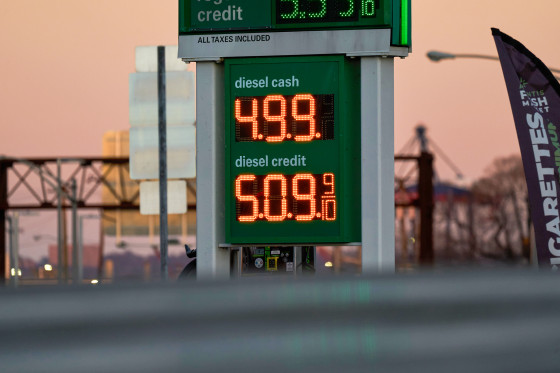
The average price of a gallon of gasoline hit $4 Tuesday for the first time since mid-2022, as the cost of oil surges due to the Iran war.

In the month since the United States and Israel attacked Iran, the average price of unleaded gas has spiked more than a dollar a gallon. On Tuesday morning, the average price nationwide was $4.02 per gallon, motor club AAA said.

It’s not just retail gasoline. The diesel fuel used to power trucks delivering goods to stores, farm equipment and public transit has risen to $5.45 per gallon, more than $1.80 higher than it was a year ago.

Driving that is the soaring cost of crude oil worldwide. U.S West Texas Intermediate (WTI) crude has risen more than 50% since the war began Feb. 28, while Brent, the international benchmark, has seen a jump of nearly 60%.

On Monday, U.S. crude oil settled above $100 per barrel for the first time since Russia’s full-scale invasion of Ukraine in 2022. Brent crude oil is poised to see its largest one-month increase on record.

Oil prices had already started rising before the Iran war began, fueled by fears that a conflict was imminent. Since the start of the year, the cost of U.S. crude oil is up more than 80% and Brent has skyrocketed almost 90%.

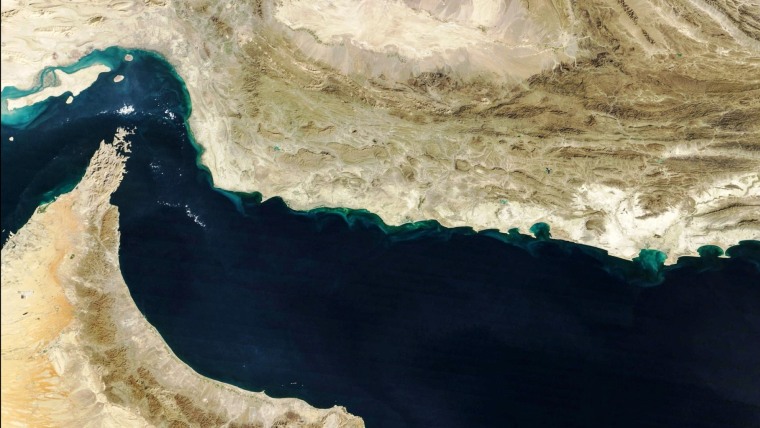
In response to strikes by the U.S. and Israel, Iran has effectively blocked shipping through the Strait of Hormuz, a critical channel off its southern coast. Tehran has also attacked its Gulf Arab neighbors, who are major oil producers.

Typically, more than 20% of the world’s oil supply moves through the waterway. But Iran has repeatedly threatened to attack ships if they move through the strait without permission or if they’re associated with the U.S. or Israel. Several tankers have been hit.

As a result, many tankers are stranded in the Persian Gulf, unable to deliver their products to markets.

Some tankers have been allowed to pass through the strait, including one associated with India and three associated with China. But overall traffic through the waterway is down more than 90% in March.

During the first 28 days of the war, a total of only 55 to 60 tankers have cleared the Strait of Hormuz, according to the ship tracking website TankerTrackers.

Before the war, more than 100 ships per day made the passage, it said.

“This rise in gasoline spending could potentially dampen consumers’ ability to spend on ‘nice-to-have’ or discretionary categories,” Bank of America economists recently wrote.

This year, the average U.S. household will spend an additional $740 on gas because of the jump in oil prices, according to economists from the Stanford Institute for Economic Policy Research.

“The consumer has already seen the sticker shock from rising gasoline prices and increased airline ticket prices from the rising cost of jet fuel,” longtime industry analyst Andy Lipow said. “However, the full effects of the higher diesel prices has yet to be felt and that will flow through the economy over the next few months.”

As American consumers adjust to higher gas prices, oil dependent nations in Europe and Asia are already facing much more severe energy shocks. Inflation, oil and gas rationing and sharp pullbacks in economic growth estimates are impacting billions of people worldwide.


American flyers still smarting from interminable airport security lines are about to get another shock.

A looming global jet fuel shortage is expected to hike the cost of air travel and reduce flight schedules, as airlines look to offset rising prices.

On Monday, JetBlue announced it was raising baggage fees, citing “rising operating costs.”

“While we recognize that fee increases are never ideal, we take careful consideration to ensure these changes are implemented only when necessary,” the carrier said.

United Airlines CEO Scott Kirby said costs to passengers have already been increasing. Data from flight information group OAG shows average airfares in the past week reached $465, the highest price point for the same period since at least 2019.

“We have to raise prices to deal with higher fuel prices,” Kirby acknowledged at a company event last week in Los Angeles. In a subsequent memo, he added: “It may be a challenge to continue passing through much of the increased fuel price if oil stays higher for longer.”

The rising prices are the latest example of the economic fallout from the war with Iran. Analysts have started warning that the full toll has only begun to be accounted for as the global economy absorbs the loss of critical energy exports out of the region due to the closure of the Strait of Hormuz and damage to other key energy infrastructure sites in the region. On Tuesday, U.S. gasoline prices hit $4 a gallon for the first time since 2022 amid surging oil prices. Major stock indexes, meanwhile, have fallen by nearly 10% since the start of the war.

In the case of air travel, the industry is facing jet fuel prices that have surged 85% in the U.S. since the day before the war began in February, according to data from Argus published by the industry group Airlines for America. On Monday, they hit a record $4.62 a gallon.

Most U.S. carriers no longer hedge fuel costs, said Henry Harteveldt, president of Atmosphere Research Group. So they are forced to pass on some costs to passengers.

While U.S. carriers largely source jet fuel domestically, countries in Asia and Europe that are more reliant on Middle East stocks have begun signaling they are taking unprecedented measures to conserve jet fuel. In South Korea, carriers have requested that the government help redirect fuel stocks bound for export back to local markets.

The Financial Times reported Monday that the U.K. was also facing an acute shortage, with no Britain-bound cargoes visible on the water as transit through the Strait of Hormuz remains blocked. Some foreign carriers have begun charging fuel surcharges of as much as $150.

As overseas carriers begin looking to alternative supply bases, the cost for a global commodity like jet fuel rises across the board.

“It shocks the entire mechanism,” said Jaime Brito, an executive director at Oil Price Information Service consultancy.

President Donald Trump commented on the jet fuel shortages Tuesday morning, though he did not mention their impact on U.S. travelers.

“All of those countries that can’t get jet fuel because of the Strait of Hormuz, like the United Kingdom, which refused to get involved in the decapitation of Iran, I have a suggestion for you: Number 1, buy from the U.S., we have plenty, and Number 2, build up some delayed courage, go to the Strait, and just TAKE IT,” he wrote on Truth Social.

Airlines are also signaling capacity cuts to cope with rising costs. United will drop about 5% of planned flights in mostly “off-peak periods” — like red-eye and midweek routes — during the second and third quarters of 2026 to further mitigate the cost increases.

“We’re certainly going to be nimble in terms of capacity to make sure that supply and demand stay in balance,” American Airlines CEO Robert Isom said at a JPMorgan conference earlier this month.

Kyle Potter, executive editor of the Thrifty Traveler, said most carriers have quietly been raising airfares since the Iran war began. He said airlines typically move in droves when making pricing decisions, so it is likely that other carriers may also soon begin raising baggage fees or seek other forms of ancillary revenue. Potter noted that unlike airfares, revenues from these fees are not subject to federal excise taxes.

As a result, the fees — unlike airfares — are unlikely to come back down assuming jet fuel prices recover.

Representatives for five other major U.S. carriers did not respond to a request for comment.

The acute fuel price increase comes as air travel demand has remained steady, with January and February ticket sales at or near records. While investors have taken airline stocks down some 25% since the start of the Iran war, Kirby said that customers appear willing to keep booking thanks to healthy demand even if airfare rises.

“The number of wealthy Americans who are traveling is bigger and wealthier than ever, and that is what much of the airline industry is relying on right now,” Potter said. “And that means they’re more immune to higher fees, higher fares and just getting turned off by negative news about travel.”

Colombian officials discovered a body Friday amid the search for a U.S. flight attendant who went missing in the country last weekend.

Medellin Mayor Federico Gutiérrez announced the discovery in a post on X, saying that “a lifeless body has just been found between the municipality of Jericó and Puente Iglesias,” in the northeast region of the South American country.

The mayor said the body was likely that of Eric Fernando Gutierrez Molina, a 32-year-old American Airlines flight attendant from Texas who vanished while out with colleagues in Medellín, Colombia, during a layover.

“There is a very high probability that it is this person. The lifeless body is being transported to legal medicine in Medellín for identification and recognition,” Gutiérrez wrote on X. “We express our solidarity to his family and friends. I have just personally delivered the painful news to his father, who is in Medellín.”

Gutiérrez also said authorities suspect foul play, adding that officials “have very clear leads on those responsible” and calling for those individuals to be sought through extradition.

The mayor said he informed the U.S. ambassador to Colombia of the discovery. The State Department did not immediately respond to a request for comment, nor did Gutierrez Molina’s family.

In a news briefing, Medellín Security Secretary Manuel Villa said Gutierrez Molina was in Colombia on business and was out in the city of Itagüí with two co-workers that he identified as a man and a woman. Gutierrez Molina and the man then left the first establishment to go to a second location with others, also in Itagüí.

“And from there, once they left, there has been no further information on the whereabouts of Eric,” Villa said. “The woman arrived at the hotel where she was staying. However, she arrived somewhat disoriented.”

Villa said law enforcement have determined through their investigation that Gutierrez Molina and the woman encountered individuals “with a history of committing theft under the influence of scopolamine.”

The investigation remains under investigation and national police are still deployed throughout the area, Villa said.

Gutierrez Molina’s sister, Mayra Gutierrez, said in a phone call earlier this week that her brother had been out with another crew member over the weekend. She said the family last heard from him in the early hours of Sunday and confirmed that he worked for American Airlines.

American Airlines did not immediately respond to a request for comment. In a statement earlier this week, the airline said it is “actively engaged with local law enforcement officials in their investigation and doing all we can to support our team member’s family during this time,” but did not mention Gutierrez Molina by name.

President Donald Trump said Sunday that he would like to “take the oil in Iran” and is considering seizing the export hub of Kharg Island, which is responsible for more than 90% of Iran’s oil exports.

In an interview with the Financial Times, Trump said his “preference would be to take the oil.”

“To be honest with you, my favorite thing is to take the oil in Iran but some stupid people back in the U.S. say: ‘Why are you doing that?’ But they’re stupid people,” he said.

The interview marks some of Trump’s most direct comments about his thinking on what to do with Iran’s oil.

In an interview with NBC News this month, Trump sidestepped answering whether he had plans to try to take Iran’s oil.

“You look at Venezuela,” he said. “People have thought about it, but it’s too soon to talk about that.”

In January, the U.S. captured Venezuelan leader Nicolás Maduro and proceeded to take more control over the country’s oil industry.

The White House did not immediately respond to a request for comment Sunday night.

Trump told the Financial Times on Sunday that the U.S. has “a lot of options,” including potentially taking Kharg Island, a rare island made of hard coral off Iran.

“Maybe we take Kharg Island, maybe we don’t. We have a lot of options,” Trump said. “It would also mean we had to be there [in Kharg Island] for a while.”

Oil prices have skyrocketed around the globe as the war continues, with U.S. crude oil costing over $100 a barrel Sunday.

Thousands more U.S. troops are heading to the Middle East, with the USS Tripoli arriving on Saturday as part of a complement of 3,500 troops. But Trump and his administration continue to signal that they are working to negotiate a 15-point proposal to end the war.

Trump declined Sunday to offer specific details about whether a ceasefire deal could be reached in the coming days to reopen the Strait of Hormuz, a critical waterway used to move about 20% of the world’s oil exports.

“We’ve got about 3,000 targets left — we’ve bombed 13,000 targets — and another couple of thousand targets to go,” Trump said in the Financial Times interview. “A deal could be made fairly quickly.”