WASHINGTON — House Republicans voted Friday evening to pass a short-term funding bill for the Department of Homeland Security that has no viable path in the Senate and is likely to extend the shutdown stalemate on Capitol Hill.
The vote of 213-203 came after Speaker Mike Johnson, R-La., rejected the Senate-passed bill, which would fund all of DHS except Immigration and Customs Enforcement and Customs and Border Protection. Funding for DHS lapsed in mid-February.
He called the Senate measure “a joke,” placing full blame for it on Democrats, even though Republicans control the Senate and the bill passed by unanimous consent early Friday morning.
“They have taken hostage the funding processes of government so that they can impose their radical agenda on the American people,” Johnson told reporters before the House vote.
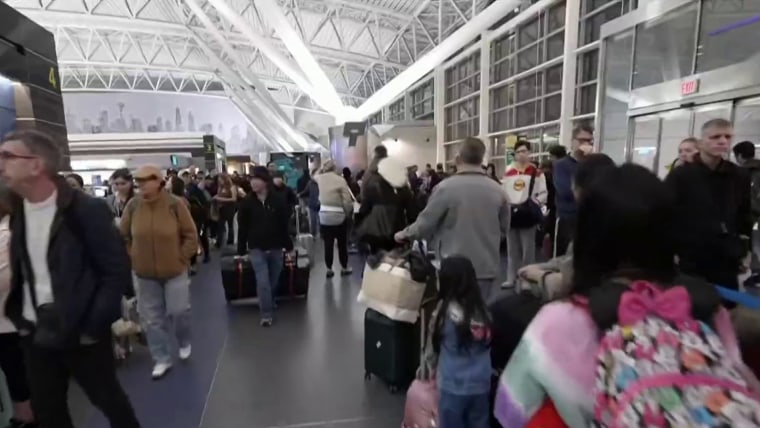
His remarks came around the same time President Donald Trump signed an order directing the Department of Homeland Security to pay Transportation Security Administration employees who have missed paychecks during the DHS shutdown, leading to high TSA callout rates that have created long lines for passengers at U.S. airports. The dollar amount and authority for tapping the funds was not immediately clear, but a DHS spokesperson said paychecks should start arriving as early as Monday.
We’d like to hear from you about how you’re experiencing the partial government shutdown, whether you’re a TSA agent who can’t work right now or a federal employee who is feeling the effects at your agency. Please contact us at tips@nbcuni.com or reach out to us here.
The House-passed bill, which would fund DHS through May 22, is not expected to become law. The Senate left town Friday for a two-week recess, and Democratic senators have consistently vowed to block funding for ICE and CBP without constraints on immigration enforcement operations.
Asked if Trump has endorsed his plan, Johnson told reporters on Friday afternoon: “I spoke to the president a few moments ago; he understands exactly what we’re doing and why, and he supports it.”
Senate Majority Leader John Thune, R-S.D., has no plans to bring back the Senate because there is no realistic path to passing the House bill, a GOP aide told NBC News.
The belief among Senate Republican leadership is that it does not make sense to pursue a path other than the bipartisan bill to fund the Department of Homeland Security, minus ICE and CBP, that the Senate passed early Friday morning, according to a senior GOP aide.
The Senate over the past six weeks has attempted to pass numerous measures identical to the one passed by the House on Friday night, and all have failed in the face of Democratic opposition.
Senate Minority Leader Chuck Schumer, D-N.Y., warned that a House bill that funds ICE and CBP without guardrails would go nowhere in the Senate, where it would require 60 votes to advance. Republicans hold a 53-47 majority.
“We’ve been clear from day one: Democrats will fund critical homeland security functions — but we will not give a blank check to Trump’s lawless and deadly immigration militia without reforms,” Schumer said, adding that the House GOP’s short-term funding bill would be “dead on arrival in the Senate, and Republicans know it.”
House Minority Leader Hakeem Jeffries, D-N.Y., sided with Schumer in favor of the Senate-passed bill.
“We have this bipartisan bill sent over by the Senate that House Democrats are prepared to support,” he told reporters Friday. “If that bill is brought to the floor today it will pass. The Trump-Republican DHS shutdown will be over. Unfortunately, MAGA extremists in the House of Representatives continue to inflict pain on the American people.”
Johnson put forward the short-term funding bill after a bloc of House conservatives expressed outrage over the Senate-passed measure and vowed to vote against it, complicating any move toward swift passage in the House.
Rep. Ralph Norman, R-S.C., called the Senate bill “irresponsible” and added that voter identification provisions and parts of ICE funding must be included.
“Those two things will have to be in,” he said.
Rep. Susie Lee, D-Nev., said Democrats won’t support a bill to fund ICE without constraints after immigration enforcement agents killed two Americans in Minneapolis.
“I think we made it very clear, and the American public is demanding some sort of guardrails on an agency that has basically terrorized communities across this country, resulted in the death of two American citizens,” she said. “We have shone a light on just how rogue ICE was acting.”
Leaving the Capitol on Friday, Johnson told NBC News that he gave Thune a heads up before deciding to reject the Senate-passed measure and its omission of funding for ICE and CBP.
“We talked today, and I told him it shouldn’t be a surprise to anybody we would not be able to do that,” Johnson said. “We’re not going to split apart two of the most important agencies in the government and leave them hanging like that. We just couldn’t do it.”